
The Semiotic Triangle – Term, Concept and Object Explained
The semiotic triangle describes the relationship between a term (designation), a concept (mental unit), and an object (a real or imagined entity). It explains how meaning arises in technical language and forms a core foundation of terminology work and terminology management.
How does meaning arise in technical language? Why do different designations for the same object lead to misunderstandings – and why does a clearly defined concept bring structure to complex content? The semiotic triangle – in terminology work often interpreted as the semantic triangle – provides a structured answer.
The semiotic triangle in practice: LUMIO and Blue
The semiotic triangle is easier to understand when viewed in a real working situation. Imagine Mira returning to a laboratory after a longer absence. She sees a new medical device, reads its manual, learns its official designation LUMIO and later hears colleagues referring to the same device as Blue.
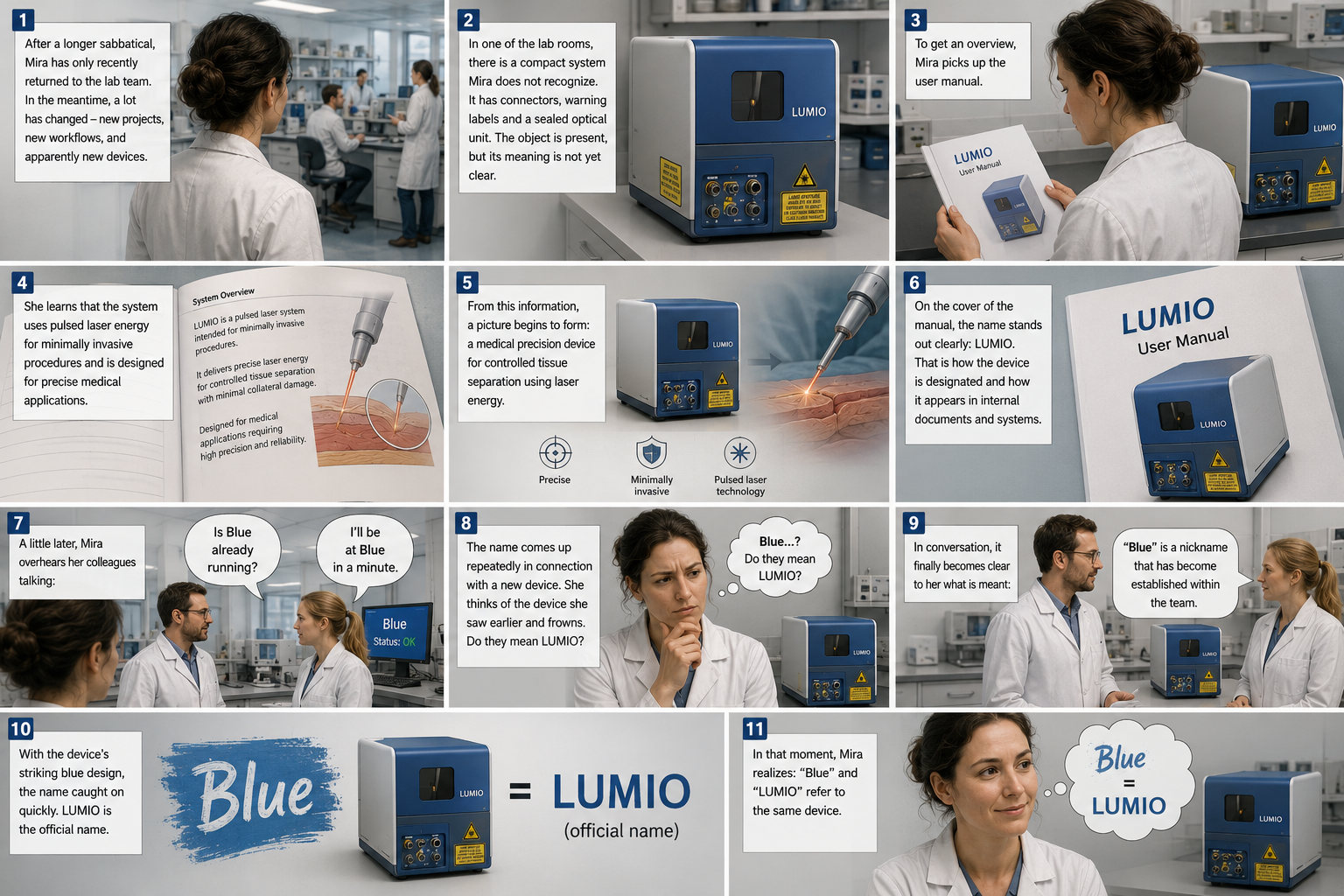
At first, the two names seem unrelated. Eventually Mira realizes that both designations refer to the same concept and the same physical object. This is exactly the relationship described by the semiotic triangle.
In terminology work, this model is fundamental. It makes visible how terms, concepts and objects are interconnected. On this basis, technical terminology, translations and knowledge bases can be built consistently – for example in a terminology system like flashterm. This understanding aligns with standards such as ISO 704, which emphasize concept-oriented terminology management.
Semiotic vs. semantic triangle
In practice, the terms “semiotic triangle” and “semantic triangle” are often used synonymously. However, they differ in their disciplinary perspective:
| Aspect | Semiotic triangle | Semantic triangle |
|---|---|---|
| Discipline | Semiotics | Terminology, linguistics |
| Focus | General function of signs | Meaning and concept structure |
| Objective | Understanding how signs convey meaning | Systematic terminology work |
| Perspective | Epistemological | Application-oriented (e.g. ISO 704) |
| Typical terms | Symbol – Thought – Referent | Designation – Concept – Object |
For terminology work, the semantic perspective is particularly relevant, as it forms the basis for standardized, concept-oriented systems.
What is the semiotic triangle?
This model can be described systematically:
The semiotic triangle shows how designation, concept and object are related – and why different names can still refer to the same thing.
The semiotic triangle goes back to Ogden and Richards and describes the relationship between linguistic signs, mental concepts and reality.
For terminology work, this model can be applied and refined with precision.

At its core, the model consists of three interconnected levels:
The concept is the mental unit defined by its characteristics, for example “optical output power of a laser”.
The term is the linguistic designation of that concept, such as “laser output power”, “patient protection filter” or a product name.
The object, finally, is the real or imagined entity, for example a specific laser device in a laboratory or operating room.
Example: mapping LUMIO and Blue to the semiotic triangle
The story of Mira, LUMIO and Blue can be mapped directly to the three levels of the model:
| Element of the model | Example from the story |
|---|---|
| Object | The physical medical laser device in the lab |
| Concept | Medical precision device for controlled tissue separation using laser energy |
| Official designation | LUMIO |
| Informal designation | Blue |
Different designations can refer to the same concept. The concept itself refers to an object. Terminology management makes these relationships explicit, reliable and reusable across documentation, translation, product communication and internal knowledge systems.
The relationships within the triangle
Clear relationships exist between these three levels:
The concept arises from our interaction with objects. It captures the characteristics that are relevant for technical communication.
A term designates a concept based on linguistic convention. Professional communities, organizations or standards determine which designation is used.
The term itself is not directly linked to the object. It always refers to the object via the concept.
A short story to illustrate the model
After a longer sabbatical, Mira has only recently returned to the lab team. In the meantime, a lot has changed – new projects, new workflows, and apparently new devices.
In one of the lab rooms, there is a compact system Mira does not recognize. It has connectors, warning labels and a sealed optical unit. The object is present, but its meaning is not yet clear.
To get an overview, Mira picks up the user manual. She learns that the system uses pulsed laser energy for minimally invasive procedures and is designed for precise medical applications.
From this information, a concept begins to form: a medical precision device for controlled tissue separation using laser energy.
On the cover of the manual, the name stands out clearly: LUMIO. That is the official designation used in internal documents, user manuals and systems.
A little later, Mira overhears her colleagues talking: “Is Blue already running?” – “I’ll be at Blue in a minute.”
The name comes up repeatedly in connection with a new device. She thinks of the device she saw earlier and frowns. Do they mean LUMIO?
In conversation, it finally becomes clear to her what is meant: Blue is an informal nickname that has become established within the team. With the device’s striking blue design, the name caught on quickly.
In that moment, Mira realizes: Blue and LUMIO refer to the same concept and the same device.
Why the semiotic triangle matters in terminology work
The example shows why terminology work is not limited to collecting words. It clarifies how objects, concepts and designations relate to one another. This is especially important when official product names, informal nicknames, synonyms, abbreviations and translations coexist in the same organization.
- Concept level: definitions, characteristics, domain structure
- Term level: preferred terms, synonyms, rejected terms, languages
- Object level: physical devices, products or processes
Terminology systems such as flashterm follow exactly this principle: establish clarity at the concept level first – then manage consistent designations for different communication contexts.
Frequently asked questions about the semiotic triangle
What is the difference between a term and a concept?
A concept is a mental unit defined by characteristics. A term is the linguistic designation of that concept. Multiple terms can designate the same concept.
Why does a term not refer to an object directly?
A term refers to an object only via a concept. Without the conceptual level, designations become ambiguous and technical communication becomes unreliable.
Why is the semiotic triangle important for terminology work?
The model helps separate designations, meanings and real-world entities and objects clearly and manage them systematically – especially in multilingual technical communication.
Can several terms refer to the same concept?
Yes. Several designations can refer to the same concept, for example an official product name, an informal nickname, an abbreviation or a translated term. Terminology management records these relationships so that communication remains consistent and unambiguous.
Which standards are relevant for terminology work?
Key standards include ISO 704, which defines principles and methods of terminology work, and ISO 1087, which establishes the fundamental concepts and vocabulary of terminology.
Conclusion
The semiotic triangle is more than a theoretical model. It is a practical way of thinking for anyone working with technical language, translation or knowledge management. Keeping term, concept and object clearly separated creates clarity – and helps avoid costly misunderstandings.
From model to data structure
Model concepts and terms in flashterm
See definitions, synonyms, and multilingual terms come together at concept level.